
Right Brain – Left Brain Integration

right_brain_integrationLast fall, it was data-driven marketing I declared as the new black when I cited a recent NYT article glamorizing what had traditionally been the realm of geeky good with numbers types (like, ahem, yours truly). Data-driven marketers, it said, are a hot new business persona that looks something like Madison Ave. meets Wall Street: Don Draper meets Gordon Gecko. At last! Those who actually enjoy manipulating spreadsheets, know the difference between a mean and a median, love to talk about outliers and statistical confidence, experimental design and hypothesis-driven adaptive strategies could come out. “Hi my name is Bonnie and I’m a dataholoic,” I could finally admit—and become fashionable!

This fall, I’ve discovered that the right brain is the new black and I’m just as thrilled. “Hi my name is Bonnie and I’m a closet creative,” I can proclaim with dignity. What’s hot this year? Emotion, context and meaning. Story telling, passion, values and experience—all very right brain and very, very fun.

But wait – am I a dataholic or a closet creative? Could I perhaps be both? A great way to find out is to ask yourself is, “Do I think in words (analytical/left brain) or pictures (creative/right brain)?”

My assessment is that I am both. I had to stop and think when that question was put to me recently. I didn’t have an immediate idea as to whether my thought patterns were language-driven or pictorial. I was told that those who stumble over this question and hesitate to choose are indeed both—equally right and left brain oriented.

It seemed a tough pill to swallow. For my left brain, anyway. It likes definition, categories, simple and neat explanations. Pondering upon this, I lamented that I can never claim complete loyalty to either side of my brain, destined as I am to live in both hemispheres, born of mixed-hemisity, bi-hemisual (don’t you love coining a neologism? very right-brain), living half my consciousness in linear analysis, words, language and the other in non-linear synthesis, pictures, and possibilities.

But then my right brain remembered a catch phrase I heard a year or two ago, “We need to stop chasing either/or and start reaching for and.” And I realized: Being bi-hemisual means I can don which ever is in season—right brain or left—and look equally as fetching.

Right Brain Workout

right_brain_workoutSpeaking of right brain, I recently had the good fortune to work with an interesting social business, TeamWorks. Far outside my B2B marketing technology wheelhouse, the positioning and awareness building done for this cooperative business network was a welcome stretch for me and a rare opportunity to go full-on right brain with the production of a new video declaring for TeamWorks who they are, what they do and where they’re headed. I wrote, produced, directed and edited this 8-minute piece for an audience of potential donors and advisors—in two very full weeks—giving my right brain one mother of an exhilarating workout. Check Out TeamWorks on YouTube.

BTW: TeamWorks is a very cool organization in a burgeoning, dynamic and very interesting space: Social business. These are typically for-profit businesses, but guided by a social mission. In TeamWorks’ case, the mission is to reduce poverty. TeamWorks gives traditionally low-wage service workers an opportunity to get out of poverty by helping them to start and run employee-owned business cooperatives.

Right Brain Renaissance

right_brain_renaissanceIn A Secret History of Consciousness, Gary Lachman (among many other very interesting musings) muses that the Internet could be the harbinger of a right brain renaissance. The decisively non-linear, highly contextualized way content is displayed and digested online, he says, moves markedly away from its hugely linear predecessor, the printed page.

Language functions such as grammar and vocabulary have long been attributed to the same hemisphere said to control linear reasoning—the left. But because the way we consume information while moving across web pages involves not just language, but visual and audio cues across many more complex spatial relationships, it’s the right hemisphere that’s getting the workout when we go online.

What’s more, the right brain tends to kick in more when presented with novelty while the left takes over the more routine processes. With its constantly emerging nature, the Internet is nothing if not constantly novel, apparently giving more right brains more exercise since, according to Lachman, the advent of language.

The Internet has long since been identified as an economic game-changer, profoundly impacting not only product innovation, but employment distribution, shopping patterns, manufacturing priorities and, of course, social interactions. Could it be so all-powerful, so far reaching that it could substantially change the way we use our brains? If, as Lachman professes, consciousness and the mechanisms for learning are indeed one in the same, totally interdependent and constantly emerging, no doubt future historians will claim the dawn of the Internet era as at least as influential to man’s development as the acquisition of language, tools and agriculture.

BTW: Gary Lachman was the lead guitarist for Blondie throughout the 70s and 80s, now lives in London and is the tireless chronicler of culture, consciousness, mysticism and the occult.

America’s Love Affair with Being Dialed-in

pony_expressLess than 100 years after Paul Revere’s famous ride, cementing the American capacity for—and success with—the power of the network, the nation’s eastern half had swelled to the outskirts of Missouri—St. Joseph, Missouri to be exact—then considered the very outpost of civilization.

Between the hinterlands of St. Joseph and the booming economy of San Francisco lay a vast dead zone, thousands of miles of nothing but wilderness and hostile forces. Any communication at all would take an arduous, indeed perilous journey of 20 days or more to get through. Can we even imagine waiting 20 days for the results of a presidential election or news of the Civil War?

Indeed not!

Such was our interest in cutting down on the communication time between San Francisco and St. Joseph Missouri that for a few years in the early 1860s, too impatient for telegraph wires to be strung, we could hire the Pony Express to cut the time in half, riding non-stop at full speed for 10 full days and nights.

Bankers and merchants were among the first customers, happily handing over the then exorbitant rate of $5 US for one letter. The Pony Express was perhaps America’s first flash-in-the-pan startup, going from zero to 300 employees back to zero again from 1860 to 1862.

The wireless did it—killed the Pony Express. Then the telephone killed the wireless, and the cell phone killed the telephone (how many of us use or even have land lines anymore?). Each new device designed not just to communicate, but to make communication ever more immediate. Don’t have to walk down to Western Union anymore, you can have the message come right into your house with the telephone. Don’t have to be in your house to get a call any more, you can have the message sent right to your very person.

Waxing cynical for a moment, we can envision a future of cranial-implants, chips that put a Facebook crawl right into our awareness, bypassing our senses completely.

Ok, that’s silly.

CB radios, walk-talkies, cell phones, texting and instant messaging. Americans have only ever demonstrated an insatiable appetite for more and faster ways to communicate. There’s no telling where our insatiable appetite for networking may lead us.

Social Media: The Death Knell of Elite Opinion?

buzzards2The New York Times recently asks, do elite thinkers matter anymore? Big commentator analyses of current events today drown in a sea of collective voices blogging and tweeting real-time thoughts, as they occur. By the time Obama’s first White House address was over, public opinion was already formed. No need for a week or so of fallout, reviews or media analysis to tell us what we should think. We already think.

The rise of social media has undeniably diluted influence, changed the way conventional wisdom is formed and freed culture from reliance upon the elite few for getting things done. That Obama won the white house by going straight to the masses online while Hilary cozied-up to the Democratic establishment to no avail is testament to the dramatic dilution and decentralization of our political system.

Our current president is the first in history not to have risen through the ranks of partisan politics over a couple of decades before even thinking about a white house bid. No, this man believed he could better influence public opinion by going straight to the public. Social media technology allowed him to do so.

Although big commentators have come down hard on Obama since the oil spill, public opinion polls say his approval ratings remain largely unchanged at around 50 percent.

But the final word is by no means in. The Times article speculates that because there was an unusual consensus among pundits both left and right that the Gulf speech was flat, American opinion will eventually sway that way. We’ll see.

What to Expect from Social Media? Ask Mr. Carnegie

social_media_expectationsThe Social Media Examiner recently published a post, 7 Social Media Truths You Can Ignore and still be Successful. In it, Rich Brooks deftly points out that Claim #1: Social Media Has Changed Everything is nothing more than hooey.
I thought I was the last one with a copy of Dale Carnegie’s seminal How to Win Friends and Influence People on my shelf, but apparently, Rich has one too. He reminds us that anyone who feels disappointed with their Twitter ROI is well to be reminded that Twitter is just social network—just like the one Dale cultivated way back in the 1930s—and that it’s purpose is to win friends and influence people, not change everything. Granted, online social networks operate at lightening speed. But fundamentally, what we call social media—Twitter, Facebook, forums, user groups and review sites—are just plain old social networks that happen to live online.

So what can we learn from the original social-networking-for-business thought leader? Carnegie’s theory about friends and influence is that if you concentrate first and foremost on their cultivation (as opposed to lead gen), the revenue will follow. He posits that the cultivation of friends and influence is a subtle art form unto itself. That although social networking for business is principally a business venture, to work properly it should be practiced outside the sales environment and operate according to social principles, not selling principles.

Of course, in today’s marketing arena, our executives demand much more than our testimony that, “it sure feels like the increase in business has something to do with my networking efforts.” Fortunately, digital marketing is nothing if not accountable and there are quite a few ways to skin the social media ROI cat.

Keeping a running tally of friends and influencers is one of them. Showing that you have increased both is another. The point being that social media has its own benefits and should have its own set of metrics which may or may not include customer acquisition and probably shouldn’t include setting the world on fire.

Social media is expedient, addressable and accountable, not game-changing. Social networking technology enables opportunity. We create it with smart social networking practices—Mr. Carnegie’s are especially recommended.

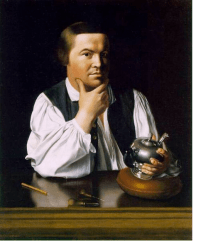
Paul Revere: The Original Key Influencer

paul_revereI caught an interesting documentary the other day suggesting that one of the key factors of success for the American Revolution was our networking ability. One thing the British hadn’t counted on: America’s ability to move information through the colonies at astonishing speed.

America, it seems, has been deeply networked since day one. Even with our colonial wings of communal will radically clipped living under British law, Americans consistently, methodically, routinely organize in groups. Powerless groups, really, who have little authority over anything—not British law, not taxes. Yet convene they do. To discuss “the concerns of the day”. To communicate, to network.

Since the first Representative Assembly in 1619 Jamestown to the first Committee of Safety in 1774 Massachusetts, America grew in tight networks—local committees who elect regional representatives who attend colonial assemblies. Veritably powerless under British law, but here, there and everywhere. Hugely connected.

Also importantly, colonial literacy was very high—the north especially enjoying nearly full literacy. Even in the less literate South, oratory and word of mouth communication was alive and fast. News of the Boston Tea party was printed, dispatched and common knowledge in every one of the thirteen colonies within days.

Contrary to popular folklore, when the British finally did arrive, what Paul Revere didn’t do was ride about shouting incessantly, “The British are coming!” What he did do was act as a key influencer. He used an existing network to tell the right people the right thing at the right time and very importantly, asked them them to tell more people. And, thanks to the Sons of Liberty, the network was already in place before the message was pushed through—a key ingredient of successful viral marketing. By the early morning, 40 or more riders were scattered across Middlesex County carrying news of the British invasion. And the rest, as they say, is history.

Google and Business: Best Frenemies

google_nyt_articleThose of us making a living in search marketing have long been aware of the pitfalls of doing business with Google which were outlined in a comprehensive look at the search behemoth in this morning’s NYT: Sure, It’s Big. But Is That Bad? Blatant self-interest, sudden unannounced changes in search algorithms and volatile ad rates have kept us on our toes, constantly having to keep up with whichever way the Google wind blows.

But we don’t take our business elsewhere. Most of us easily hand 80% of our paid search budget right over. When Google pulls another fast one – which it inevitably will, we adapt. Competitive behavior in a complex, networked economy is a slippery fish. Networks work because they are large. Networked economies (the Internet) benefit from scale (Google). We Internet marketers, although mostly irked by Google, accept that its very scale works to our benefit.

This morning’s Times article properly asks, “Can there really be monopolies online when the competition is only a click away?” We can move our paid search business away from Google and give it to Yahoo! or Bing at a moments notice. But we don’t.

And why not? Because, for now, Google is where the consumers are. Doing business with Google as advertiser has always been annoying and has certainly always felt unfair, but has it really been unfair? With all the pressure we now see to derive quantifyable ROI from every dollar we spend, we prove time and again that what we spend on Google is worth it no matter how annoying or unfair.

But all is transient – especially in the world of Internet marketing. When it becomes bad business to do business with Google, we’ll stop.

Cloud Marketing – Bring it On!

cloud_marketing1I’ve long been interested in ideas about the future workplace and how it will one day look dramatically different than what we’ve known. Those of us making a living in digital services and technologies may already be experiencing it. Our work teams can easily be made up of half employees, half contractors and consultants and nearly always include at least one party who we’ve only met on conference calls because he lives in Idaho.

Having made my living as a freelancing contractor for the better part (and the worst part) of the past four years, I can only attest to its many, many benefits for both the employer and the employed alike and express a fervent hope that it truly becomes more common. It saves time, energy and money (no transportation costs! no commute!) and in my experience, contributes to a more agile marketing practice and helps companies stay nimble.

The Economist says freelance and contract work is on the rise. Whether the new pool of freelancers is simply fed up with seeking full-time employment in today’s economy, or wants to move toward the more flexible (albeit less secure) lifestyle that freelancing affords is unclear. What is clear, is that many of those who do take the leap into independence are experiencing higher quality of life, increased productivity, and even more lucrative professional lives.

Agile Marketing Must Haves

agile_must_haves
It’s difficult to find a development team that hasn’t embraced the agile method—an iterative approach to software design focused on smaller projects, shorter cycle times and lots of testing and learning. The fundamental assumption of the agile method is that project requirements change on a daily basis so being nimble matters. The old waterfall method of gathering requirements, designing, writing code, testing and releasing looks cumbersome, slow, and outdated by comparison. Not to mention more expensive and less effective.

Yet time and again, when technology-driven companies go to market, they often fail to translate their highly effective agile mindset to their marketing practice. Oddly enough, when it comes to marketing, they tend to over-think. As if they have one chance and one chance only to get it right. Their marketing practice becomes slow and cumbersome, more expensive than they’d like, and the results disappoint.

It pays to know that running a cutting edge marketing practice has an enormous amount in common with running a cutting edge development shop. Marketing, too, works better on the agile method—small projects, short cycles and lots of iteration.

Especially if you are ready to start optimizing conversion (ie: you have traffic and customers) porting your stellar agile development culture over to your marketing operation is a must.

Just like your agile development practice, your new agile marketing practice needs but a few key elements to keep it humming on all cylinders:

1. An Agile Delivery System. Today’s marketers need to make changes on a dime. Without total control over marketing web pages through a content management system that they own, they will forever spend their time requirements gathering, designing and producing ideas rather than introducing ideas to the marketplace so they can listen and adapt. Just like your agile development team needs to make frequent, pointed updates to code, your marketers need to add blog posts, change links, add and edit web copy and even full pages with pointed frequency.

2. Integrated Input. No doubt, our marketing requirements have gotten ten fold more complex in the last ten years. With multiple modalities, an explosion of technologies, fragmented communication channels and more touch points to manage everyday, it’s more important than ever to ensure that our marketing efforts are integrated—not only in the eyes of the customer, but with the fundamental workings of the organization. Integration of the sales and marketing functions has been a no-brainer for decades. Now it’s time to integrate our marketing efforts with customer service, product development and public relations, informing and coordinating our efforts, building and taking advantage of interdependencies.

3. An Iterative, Hypothesis-driven Project Schedule. Like agile software developers, agile marketers need to iterate—toss an idea into the mix, see what happens, learn, change, nip, tuck, adapt. Like developers turn stories into tasks, marketers turn hypotheses into campaigns. Like developers write and release code, marketers write and release messaging and promotions. Smaller projects, shorter cycles, iterative learning. It works very well for both.

4. Measurement. Business has long demanded accountability for the value of their software investments and your marketing efforts should be no different. As long as online marketing technology keeps innovating, marketing ROI will always be a moving target. It depends on a large number of complex inputs that will only continue to grow. That said, the same measurement principles you use in your agile development process (another complex, constantly emerging task) are also good for measuring your marketing efforts:

• Measure outcome, not output.
• Follow trends, not numbers.
• Make data easy to collect.
• Pay attention to what reveals, not what conceals.
• Collect feedback on a frequent and regular basis.
• Encourage a “good-enough” mentality and move on.

Lastly, like a development house works best when one key metric drives the business, a marketing practice works best under a single shared goal. That metric will most certainly change as your business grows. While you start out needing to drive web traffic, you’ll certainly move into the need to drive conversion and hopefully (if you’re very, very lucky) wind up faced with the need to maximize customer life time value.