For Lithium. Available for download here.
For Lithium. Available for download here.

For Rob Tarkoff, Lithium CEO. Published in the HuffPost. Viewable here.
 Just wrapped an intense but very exciting project with Lithium—the release of a new survey in partnership with the CMO Council of both consumers and marketers on their use of social media. Findings analysis, a full white paper, an infograph and a webcast—whew! It was a full sprint all the way, but I admit that’s what I love about social media marketing. It’s a fast moving train.
The survey findings underscored what we at Lithium have always known—that consumers are social, that they want and like to interact with brands through social media and that they respond to compelling social customer experiences.
But we learned a great deal as well—for instance, that all the claims that social media marketing is good for word of mouth marketing have whopping figures behind them. A full 80% of consumers say that because of social media, they are willing to try new things based on a friend’s advice. For me, this was pretty pivotal.
It’s one thing when marketers claim they are getting word of mouth advantages from social media. It’s another thing entirely when an overwhelming majority of consumers state outright that social media influences their purchase behavior. That’s some powerful data.
CMO Katy Keim was featured on the webcast and it was the perfect finale for me as I believe she has what I call the 3 As: Authenticity, Authority, and Acumen. She really puts her finger on it. And she’s thinking several years ahead. (Have a look at her deck on Slideshare—How to Get Social Business Advantage in 2012).
Yep, social works, says Katy. Maybe not all brands know that yet, but they sure will soon. And if you’re going to be competitive in the social media marketplace, you’d better make sure you’re not just connecting with your social customers, you’d better make sure you’re connecting with them in the right way.
At this year’s Lithium customer conference, LiNC, Katy introduced the concept that marketers can’t just run around collecting likes from their social customers. They have to think about building brand nations—vibrant online communities of passionate social customers. Because, after all, says Katy, “Who wants to be liked when we can be loved!”
I ran across the above clip recently from an Elia Kazan film that was way ahead of its time—A Face in the Crowd. Certainly puts to mind what our recent survey revealed and perfectly distills Lithium’s position on what marketers should do about it.
 Just wrapped up my attendance of Socialize West, a nice little 2-day conference put together by mediabistro.com The focus was Monetizing Social Media which is slightly out of my domain in my demand gen role with Lithium, but the subtitle Gamify, Mobilize, Optimize, Monetize captured my eye and I registered.
Two minutes in the door I felt right at home when I immediately met two Lithium customers, Firebelly who uses LSMM, and Vindicia who has a Lithium community. I thank the new ritual that’s propagating throughout social marketing conference culture to begin the show by being asked to “stand and shake the hands of your neighbors.” Just like church. It’s a great thing to do at a gathering.
“Now with the other hand, slap your neighbor across the face.”
Huh?
“Yep. That’s the way most digital marketers greet their social customers—by saying hello and then slapping them with a virtual communications fire hose. We’ll be here for the next two days talking about how not to do that.“
Nice opener. Certainly got our attention. That was from conference MC Todd Tweed (@audiencemachine), our hugely energetic and thought provoking host. The keynotes were terrific. Michael Bassik, Managing Director and Chair of Burson-Marsteller, gave a great presentation on crisis management and dropped these memorable lines: “The only antidote to a crisis is to address it in a very public way.” “The worst thing you can do with social in a crisis is nothing”. Certainly made me think about the financial services crisis and how banks need to listen to and reach out to their advocates now more than ever. Or, institutions like PG&E who seems endlessly to struggle with the San Bruno disaster.
Day two of course all everyone could talk about was the fact that the first place we all went after our 2 (yes, count ‘em-2!) earthquakes the day before was Twitter. We got a wonderful presentation from Brains on Fire author Geno Church (@genochurch), who in his evangelism of “marketing movements vs. marketing campaigns” gave us these sound bites: “Campaigns employ a ‘bake it and they will come’ mentality; movements are an evolution of the spirit.” “Campaigns are all about us, us, us, listen to us (we marketers); movements are about the others that are talking about us.” “Be the fans of your fans, not the other way around.”
And I promise you Mr. Church was not in Lithium’s employ when he said, “movements happen when people share their passions” and “amazing things happen when you give up ownership”. That’s exactly what we tell our customers. Let your customers drive the conversation, share their passions and start a movement. Pretty soon you’ll have a brand nation—a vibrantly community full of passionate social customers.
Later in the day I ran into my old boss Matt Roche (@matthewroche) from Offermatica (now part of Adobe/Omiture) who’s reincarnated himself as the CEO of bo.lt, an interesting new way to share web pages in personalized, permanent collections. In his optimization session, Matt reminded us that “consumption itself is a social act.”
I thought it an excellent proof point for the advice we social software providers and strategists often tell brands: “Don’t add social to your business; organize your business around social”. Consumption is a highly social thing. Geno reported earlier in the morning that 93% of us talk about brands face to face, in direct conversations with our friends, family, neighbors, teachers, co-workers … we are very social about our consumption habits already. All brands need to do is get in on the conversations that are already happening.
Lastly, I think I liked best this, again from Geno: “The future of your business should not be about technology. It should be about us—people.”
Thanks for a nice collection of marketing maxims from Socialize West and the folks at mediabistro.com.

For Lithium. Available for download here.
 Speaking of right brain, I recently had the good fortune to work with an interesting social business, TeamWorks. Far outside my B2B marketing technology wheelhouse, the positioning and awareness building done for this cooperative business network was a welcome stretch for me and a rare opportunity to go full-on right brain with the production of a new video declaring for TeamWorks who they are, what they do and where they’re headed. I wrote, produced, directed and edited this 8-minute piece for an audience of potential donors and advisors—in two very full weeks—giving my right brain one mother of an exhilarating workout. Check Out TeamWorks on YouTube.
BTW: TeamWorks is a very cool organization in a burgeoning, dynamic and very interesting space: Social business. These are typically for-profit businesses, but guided by a social mission. In TeamWorks’ case, the mission is to reduce poverty. TeamWorks gives traditionally low-wage service workers an opportunity to get out of poverty by helping them to start and run employee-owned business cooperatives.
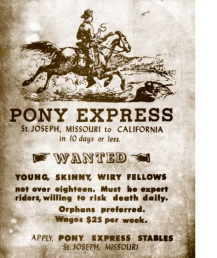 Less than 100 years after Paul Revere’s famous ride, cementing the American capacity for—and success with—the power of the network, the nation’s eastern half had swelled to the outskirts of Missouri—St. Joseph, Missouri to be exact—then considered the very outpost of civilization.
Between the hinterlands of St. Joseph and the booming economy of San Francisco lay a vast dead zone, thousands of miles of nothing but wilderness and hostile forces. Any communication at all would take an arduous, indeed perilous journey of 20 days or more to get through. Can we even imagine waiting 20 days for the results of a presidential election or news of the Civil War?
Indeed not!
Such was our interest in cutting down on the communication time between San Francisco and St. Joseph Missouri that for a few years in the early 1860s, too impatient for telegraph wires to be strung, we could hire the Pony Express to cut the time in half, riding non-stop at full speed for 10 full days and nights.
Bankers and merchants were among the first customers, happily handing over the then exorbitant rate of $5 US for one letter. The Pony Express was perhaps America’s first flash-in-the-pan startup, going from zero to 300 employees back to zero again from 1860 to 1862.
The wireless did it—killed the Pony Express. Then the telephone killed the wireless, and the cell phone killed the telephone (how many of us use or even have land lines anymore?). Each new device designed not just to communicate, but to make communication ever more immediate. Don’t have to walk down to Western Union anymore, you can have the message come right into your house with the telephone. Don’t have to be in your house to get a call any more, you can have the message sent right to your very person.
Waxing cynical for a moment, we can envision a future of cranial-implants, chips that put a Facebook crawl right into our awareness, bypassing our senses completely.
Ok, that’s silly.
CB radios, walk-talkies, cell phones, texting and instant messaging. Americans have only ever demonstrated an insatiable appetite for more and faster ways to communicate. There’s no telling where our insatiable appetite for networking may lead us.
 The New York Times recently asks, do elite thinkers matter anymore? Big commentator analyses of current events today drown in a sea of collective voices blogging and tweeting real-time thoughts, as they occur. By the time Obama’s first White House address was over, public opinion was already formed. No need for a week or so of fallout, reviews or media analysis to tell us what we should think. We already think.
The rise of social media has undeniably diluted influence, changed the way conventional wisdom is formed and freed culture from reliance upon the elite few for getting things done. That Obama won the white house by going straight to the masses online while Hilary cozied-up to the Democratic establishment to no avail is testament to the dramatic dilution and decentralization of our political system.
Our current president is the first in history not to have risen through the ranks of partisan politics over a couple of decades before even thinking about a white house bid. No, this man believed he could better influence public opinion by going straight to the public. Social media technology allowed him to do so.
Although big commentators have come down hard on Obama since the oil spill, public opinion polls say his approval ratings remain largely unchanged at around 50 percent.
But the final word is by no means in. The Times article speculates that because there was an unusual consensus among pundits both left and right that the Gulf speech was flat, American opinion will eventually sway that way. We’ll see.
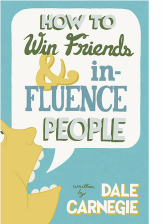 The Social Media Examiner recently published a post, 7 Social Media Truths You Can Ignore and still be Successful. In it, Rich Brooks deftly points out that Claim #1: Social Media Has Changed Everything is nothing more than hooey.
I thought I was the last one with a copy of Dale Carnegie’s seminal How to Win Friends and Influence People on my shelf, but apparently, Rich has one too. He reminds us that anyone who feels disappointed with their Twitter ROI is well to be reminded that Twitter is just social network—just like the one Dale cultivated way back in the 1930s—and that it’s purpose is to win friends and influence people, not change everything. Granted, online social networks operate at lightening speed. But fundamentally, what we call social media—Twitter, Facebook, forums, user groups and review sites—are just plain old social networks that happen to live online.
So what can we learn from the original social-networking-for-business thought leader? Carnegie’s theory about friends and influence is that if you concentrate first and foremost on their cultivation (as opposed to lead gen), the revenue will follow. He posits that the cultivation of friends and influence is a subtle art form unto itself. That although social networking for business is principally a business venture, to work properly it should be practiced outside the sales environment and operate according to social principles, not selling principles.
Of course, in today’s marketing arena, our executives demand much more than our testimony that, “it sure feels like the increase in business has something to do with my networking efforts.” Fortunately, digital marketing is nothing if not accountable and there are quite a few ways to skin the social media ROI cat.
Keeping a running tally of friends and influencers is one of them. Showing that you have increased both is another. The point being that social media has its own benefits and should have its own set of metrics which may or may not include customer acquisition and probably shouldn’t include setting the world on fire.
Social media is expedient, addressable and accountable, not game-changing. Social networking technology enables opportunity. We create it with smart social networking practices—Mr. Carnegie’s are especially recommended.
 btsite
You must be logged in to post a comment.